Shaktivada: The Vision For Action
The Science of Consciousness
Shaktivada, Asuravada and Durbalavad
Doctrines are of three types:
1) Shaktivada which neither desires to oppress others, nor tolerates any injustice.
2) Asuravada which tramples upon the natural rights of others.
3) Durbalavada which does not directly wish of oppressing others, but indirectly approves a wrongdoer by not opposing a wrong action.
Scientifically, it is impossible for anyone to choose a course of action which does not belong to any of these three categories. Without understanding the nature and implication of these three classes of thinking, it is impossible to pursue the right path. This is true for our personal life as well as for our collective (social) life.
The thought for exploitation of others is known as asuric thought and a doctrine which endorses such thoughts, is called asuravada (an asuric doctrine). Asuric people and asuric doctrines do not find natural moral support of their ambitions and actions. Therefore, they are forced to resort to propaganda based on lies, deception and trickery. In this way, they present themselves as humanitarian and create their support among people. Actually they are, by nature, utterly selfish, hedonistic and ruthless. When they grab power, their true colors become apparent through their immorality, hypocrisy and brutality.
Shaktivada uproots asuravadas. We shall not oppress others, nor shall we tolerate injustice and oppression. Asuravadis use all their power at their disposal to meet their purpose. We shall use all our power at our disposal to eradicate asuravada and asuravadis. Society is our God and its well-being is our goal. We shall root out the asuric elements in whichever way possible to pave the way for a better healthy society.
In contemporary India, the most prevalent class of thinking is durbalavada, that is, the psychology of the weakling. The durbalvadis may not be directly involved in oppressing others, but when an injustice takes place with their full knowledge or even connivance, instead of offering resistance to injustice they hush the matter up and pretend as if no injustice has ever happened. Their sermons, though composed of lofty words and delivered to all, are more aimed at the moral people than the unjust. They are extremely attached to their possessions, and always endorse the unjust lest they lose what they already possess. They consider themselves at the helm of the humanity since they view both the just and the unjust equally. In practice, however, they are the slaves of the asuric and the unjust. Though they talk of lofty ideals in their words, they surrender meekly to the asuric in their deeds.
The Law of Nature
The Shaktivadi shall inculcate the five daivi sampads (satya, prema, abhaya, shanti and tejah) in him, which, in turn, requires cultivation of physical prowess and mental strength. A scientific upasana based on the mediation of Brahmanadi (the spinal cord)—which is the source of all our energy—is crucial to maintaining inner peace and develop the daivi sampads. The asuric do not possess these virtues. They are egoist, boastful, self-praising, cruel and yet shrewd. Asuravada is extremely powerful—a million times more than any durbalavada. However, they are no match for Shaktivada.
Spinelessness is another name for durbalavada. Neither cowards can accept Shaktivada, nor can asuravada be pursued without having the daring to perpetrate atrocities. Even though, traces of daivi sampads may be observed in a durbalavadi, pursuit of durbalavada emasculates all the virtues of a person in due course of time. Asuravada is the nature’s revenge for durbalavada. When cowardice and narrow personal interest makes people shirk their responsibility toward the fellow members of society, an asuravada emerges dominant. Nature promotes a group of extremely mean people who rule and persecute that society exploiting the weakness of its members.
What is the answer to the curse of Asuravada? Shaktivada, of course. On acceptance of Shaktivada, people learn to put aside their narrow personal interest for the sake of collective well-being. Then and only then, the asuric are defeated and the asuravada disappears from that society. As long as durbalavada is prevalent in a land, there is no respite from asuravada.
Shaktivada >> Asuravada >> Durbalavada
In sum, asuravada is by far superior compared to durbalavada. And, Shaktivada vanquishes asuravada. This is true in the individual living as well as in the social living. Shaktivada demands devotion to the cause of truth and well-being of the society setting aside any personal feeling that comes in the way. When durbalavada and asurvad is dominant in the world, it is imperative on us to use all the power at our disposal for the sole purpose of eradication of asuravada and relieve mankind of misery.
The Daivi Sampads: The Difference between Shaktivada and an asuravad
In the field of action, the Shaktivadi and the asuravadi possess some common traits. Both share the ambition to annihilate the other with all the power at his disposal. Also both carry out powerful propaganda to denounce the other. What is the difference between Shaktivada and an asuravada, then? There are five daivi sampads as noted below that are prominent in the Shaktivadi’s character and conspicuously absent in any asuric person, which mark the difference.
1. Truth (Satya) – Truth is nothing but dissemination of truth. Propaganda of lies and imaginations of mind characterizes the asuric nature. This is the fundamental difference between Shaktivada and an asuravad. Once in power, asuric doctrines use all power to suppress truth.
For example, a section of Hindu Brahmins following purohita-vada (a form of asuravada) denied non-Brahmins and women the access to the Vedas (the great storehouse of knowledge).
Communist regimes proscribe any book critical of them.
Under the rule of the Church in the middle Ages, any discussion of anti-Biblical views was prohibited. We may recall the example of the great scientist Galileo who suffered tremendously because of the fact that his views on Cosmos were somewhat in contradiction with those of the Church.
Historically, Islam has been even more intolerant regarding knowledge. When Islamic forces conquer Persia, the Muslim commander sought guidance on the fate of books of that great land. To that question, the Muslim Caliph Umar issued a decree, which has served as the guideline for Islamic attitude toward alien culture for ages. His idea banks on the following “argument”:
If there is anything in those books that is in consonance with the Quran, these books are useless because those ideas are in the Quran beforehand and hence their existence on the earth is unnecessary. If that is not the case, even then these books must also be destroyed because they are written by ignorant minds spreading ignorance.1
This is the reason Islamic invaders destroyed libraries after libraries wherever they went (e.g. Nalanda University). Even to this age, Islamists maintain this position. When the debris of ancient great city of Persepolis was discovered, prominent Islamic leader Khomeini was distraught because it would unveil the marvelous Pre-Islamic past of Iran. He attempted his power to bulldoze this debris to bar any archeological excavation.2
The Shaktivadi shall always encourage free thought and be against any restriction imposed on dissemination of knowledge.
The durbalavadi heralds high his love for truth, but when truth demands even a tiny amount of action against the will of the asuric forces, the durbalavadi dispose of truth most promptly. For example, Mohandas Karamachand Gandhi’s life-long striving for truth is a myth in India. He assured innocent gullible Hindus that the proposed partition of India will be over his dead body and discouraged them from moving away from the Muslim majority areas, when they desperately wanted to do so in order to ensure safety and security of lives of their families. The cease of partition required some bold action against Islamic forces. Therefore, that was the end of Gandhi’s eternal persistence for truth! The partition happened smoothly without a scratch on Gandhi’s body and meanwhile millions were killed, and raped, and tortured, and rendered homeless.
In the same vein, a book critical of Islam usually ends up being proscribed in secular Gandhian India.
2. Love or Compassion (Prema) – Love is the Golden Rule: Do naught onto others what you would not have them do unto you.3 Asuric people seek the most from others when they are the receiving end. At the same time, these very people offer only injustice, when they have the upper hand. This is illustrative of their lack of compassion.
For example, the Communists call for strike and disruption of work to harass the establishment, when they are in the opposition. However, once in the power, they behave in the diametrically opposite manner. Communist regimes do not allow strike and crush even an iota of protest most mercilessly.
Compassion is not same as appeasement. The durbalavadis go on appeasing the asuric people against the idea of justice, and present it as their ideal of love and compassion. But the net result of this so-called “compassion” is that asuric people become more powerful and the innocent suffer even more. Gandhi could perceive a lot of good in Hitler, but wanted the Jews to commit mass-suicide in the face of Nazi barbarism.4 He would not care much about Pakistan's unprovoked invasion of India, but would like India under attack to financially contribute to violator Pakistan! Essentially, this display of so-called love and hypocritical compassion is a shenanigan to cover their lust for fame.5
Often, the durbalavadi's appeasement of the asuric is a consequence of inability of his weak mind to accept the reality. In the pre-independence period, the Gandhian Congress leadership adopted the policy of appeasement of the Muslim League by bowing to the unjust demands put forward by the League. Reservation of more and more seats in the legislative assembly for the Muslims, reservation of government jobs for them, covert support for the killing of innocent Hindu men and rape of Hindu women in the Mopla rebellion, abandonment of Vande Mataram as our national anthem are some of them. However, all these concessions neither paved the way for a peaceful co-existence of the two communities of Hindus and Muslims; nor did it create any loyalty among Muslims toward their motherland. Muslim demands grew over time, and eventually, they sought a partition of our motherland, which makes it explicit how incompetent the durbalavadi leadership was in assessing the reality.
3. Fearlessness (Abhaya) – Acceptance of something unjust out of fear indicates durbalavadi nature. Fear is the principal weapon of the asuric people. They threaten the society with dire consequences unless they go on in their way unperturbed. A durbalavadi mind surrenders to this asuric blackmail. However, a meek surrender to the asuric scheme only reinforces the asuric position. Eventually, the society pays the price with steep interest for this weakness.
We have already noted the sheepish obedience of Gandhian Congress leadership to the blackmailing techniques of the Muslim League. To avoid a large scale Hindu-Muslim riot, the Congress Leadership took up the policy of endorsing the League’s demands being utterly careless to the justification of those demands. Eventually, the society paid the price with interest by the blood of millions in the time of Partition. Millions of women of all ages were raped and brutally tortured. A whole generation of refugees from East Bengal and West Punjab grew up amidst humiliation, agony and suffering. All these constitute that price paid with interest.
A similar situation prevailed in the interbellum Europe. The contemporary British premier Chamberlain was weak to deal with the asuric demands of Hitler in the 1930s. The British premier was afraid of a tussle with the Nazi dictator and therefore bowed to Hitler’s advances in the vain effort to placate him. Hitler used this opportunity to devour many states and thereby to become powerful. Eventually, the war could not be avoided, and Hitler was so powerful by then that the prolonged war became the deadliest war of the recorded human history. Had Chamberlain acted in the proper manner, Hitler would have been a dwarf and the harm to Human civilisation would have been minimal.
Shaktivadis shall not accept anything unjust out of fear. We must overcome the fear for our mortal existence and resist the asuric designs at all cost. Death is a constant source of fear for a human being. However, there are other fears that are quite relevant in everyday life, like fear for loss of money, fame, position, friends etc. To inculcate fearlessness, we must ignore fear, whenever it stands in the way of performing our sacred duty of upholding the truth. And, gradually we shall elevate ourselves to epitomes of fearlessness.
The asuric are daring too, no doubt. But, less than the Shaktivadi who is not afraid to embrace even death for no reason but in the interest of duty to the society.
4. Peace (Shanti) – Everybody has the right to attain mental peace by following any spiritual practice of his/her choice and no one can object to that so long as none is being intruded upon over the course of this activity.
Asuric doctrines vehemently deny this right to human beings.
Islamism believes in destruction of idols of other religions. Islam says that the greatest offence of a human being is worship of a divine entity other than Allah.6 It does not permit even the Muslims to carry on worship of Allah in their own way. Mansoor Al-Hallaj, the great saint of Persia, was killed by Islamism for asserting his unity with the all-pervading Conscious Entity. Islam denounces the Christians for attributing to Jesus the Son of God, even though Christianity claims to be an utterly monotheistic doctrine just like Islam.7
The doctrine of Christianity shares with Islam the hatred for murtis8. The worship of Shiva-linga (a representation of human brain9) or any idol is prohibited under Christianity. In the Christian history, there is even ample evidence10 of persecution of idolaters.
A section of Hindu Brahmins have denied non-Brahmins the right to worship in various temples since the middle ages in a gross violation of this principle of peace. The non-Brahmins have also been deprived of their right to fundamental rituals like upanayana by the doctrine of Purohita-vada introduced by Brahmin priests.
Shaktivada insists on a collective upasana for society with the mediation of Brahmanadi (the spinal cord) and utterances of Shaktivadi hymns as rituals. We believe, not only it imbibes the society with collective spirit, but also helps all acquire the daivi sampads. Upasana helps us acquire peace which is the prime endowment to face great challenges. We call upon everyone to perform the Shaktivadi Upasana (See Appendix) for a few weeks to evaluate our suggestion from personal experience.
We are against worship of asuric and durbalvadi elements in any manner. However, we do not want to interfere in anyone’s spiritual practices and leave it to one’s personal judgment.
5. Active opposition to injustice (Tejah) – Tejah is the daivi sampad which is at the heart of Shaktivada. Without tejah, the other four divine endowments by themselves can not lead us to Shaktivada.
The asuric doctrine, the asuric behaviour and the asuric person must be stopped and this is the most important duty of a human being. Setting aside all personal obligations, infatuations and even feelings, the Shaktivadi shall deliver his/her best to uproot the asuric nature from this world. Man's progress in the evolutionary path is natural, which is thwarted by the asuric, being assisted by the durbalavadis in their mission. Therefore, opposition to the asuric is the greatest service to man.
The durbalavadis often pay lip service to other four daivi sampads discussed before but never to this one.
People often equate this greatest daivi sampad with anger. Anger is an asuric sampad, which comes when merely one’s personal ambitions are frustrated; while tejah is the natural reaction to injustice in humans.11 A Shaktivadi is agitated and furious over the asuric not for his personal reason, but for the social cause.
The story of Arjuna on the eve of the Kurukshetra war as narrated in the Mahabharata is particularly inspiring in this context. Arjuna was a valiant warrior who was least afraid of loosing his life. However, he feared quite reasonably that he had to suffer the loss of most of his kith and kin in the ensuing battle; and out of this weakness, he was quite prepared to accept the immoralities of Duryodhana. At this juncture, the greatest Shaktivadi Krishna interfered to guide Arjuna who finally realised that welfare of the society through total destruction of the asuric is the foremost responsibility and any personal loss must be immaterial for this cause.
We repeat, the Shaktivadi shall not fight for personal ambition, but for the sake of societal welfare. For the society, we strive to root out every asuric person. We act to corner each asuric and durbalvadi doctrine that is poisoning people’s mind and thereby augmenting the misery of this world. We cherish vengeance for injustice meted out to the innocent. We nourish hatred for each atrocity perpetrated on the just. The fight for truth and justice is the only thing sacred to us; anything else is dispensable for that purpose.
Durbalavadis are shuddered to deliberate on ideas like “vengeance”, “hatred”, and “fight”; for, they are coward, weak and morally vacuum. The idea of morality to them is preaching of high sounding ideals, which can provide no effective guidance to solve the problems of this world. Their sense of judgment is equivalent to a verdict of guilty to both the parties in a conflict. Their idea of open mind is to accept every doctrine (every religion) as true. They might talk of anything from internationalism to democratic outlook to Gandhian non-violence to pluralism and composite culture. But, in essence, they are self-centered, egoist, hypocrite and lustful seekers of fame. Their mind is utterly unsuitable to be able to think about the broad considerations of the society rather than narrow personal calculations.
The Shaktivadis shall not take any pre-conceived notion as granted and always judge everything from the facts, empowered by the science of Shaktivada as a tool-in-check. We shall not be susceptible to hypocrisy and idealistic ivory-tower views.
The Heterogeneity of the Human Society and the Evolution of Consciousness
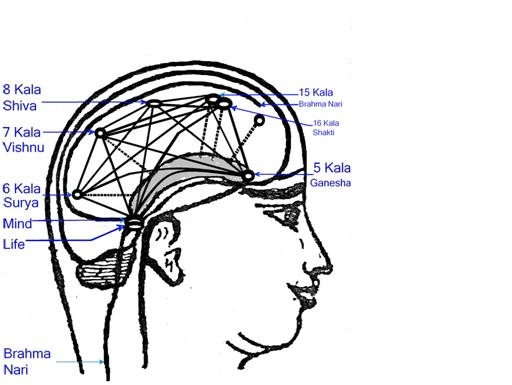
There are different occupations in the society and not all of us are equally capable for all of them. This is because different jobs require different skills and depend on different nerve-centers of the brain. A human being rarely has all the nerve-centers of the brain equally developed. This difference in proficiency and capability among human beings is called the evolution of consciousness.
To clarify, it must be stated that the evolution of consciousness is not limited to the human species. Consciousness or ability to perform an activity is developed differently in different creatures. The absolute development of consciousness is divided into 16 parts – each part being known as kala. The first kala is the vegetation and plants. In the second kala, there comes the amoeba and insect. This means that insects are, in some sense, superior to vegetation and plants in their consciousness and ability. However, in the society, both of them are indispensable and have their roles. None can take up other’s role. This is true for every kala. The oviparous (the reptiles and the birds) and the mammals constitute the third and the fourth kala respectively.
The lowest developed human beings are developed as a little more than four kalas. They are called the lower development of Shiva. These people are simple minded - satisfied just with basic things like bread, shelter and wife (husband). They are neither ambitious, nor intelligent. They are fond of simple lives and are satisfied with the least. They don’t think much about the future and possess little far-sightedness. These people constitute the majority. People at this stage of development are in plenty among porters, laborers, guards, binders, orderlies, cooks, small hotel owners, press compositors, sweepers, drivers etc.
The fifth kala is known as the Ganesha kala. These people are modest (not egoist), anti-injustice, self-abnegating, fond of war, broad minded, slightly adamant. These men possess integrity of character, endurance, patriotism, devotion toward justice and material sciences, courage etc. They talk firmly and never believe anything in blind faith. In the path of advanced development, this character is the best. People from this stage are more in common among the judges, overseers, engineers, scientists, archeologists, youth leaders. They are tough-hearted. The ideal of Communism came from this type of development.
Human beings from the sixth kala have the center of Surya in their brains well-developed. They are loving, amiable, calculating, talented, famous, theist, emotional. When torn between two opposing views, they try to placate both sides. They crave for ideal more than the goal. Any affectionate woman has development of this stage. These kinds of people are more abundant among teachers, professors, advocates, physicians, diplomats, preachers, orators, journalists, priests, singers, poets, ones running charity missions, ones following the path of Vaishnava dharma, supporters of non-violence, railways workers, government clerks, astrologers. They do support truth, but cannot stand against the society for the sake of truth. Their weakness is in their greed for fame and popularity. The creators of the durvalvadi doctrines are from this category.
Men from the seventh kala (Vishnu) are able administrators and are grossly divided into three categories - 1) the asuric Vishnu, 2) the Shaktivadi Vishnu with daivi sampads, and 3) the ill-developed Vishnu.
Figure 1: The centers of different nerves in the human brain
The persons from both category (1) and (2) are commanding, extremely intelligent, reserved and crafty in nature. They possess different things in their minds and words as well as in words and actions. They are usually suspicious by nature, but mostly none can realize that. They possess organizational skills. They are hedonist and not at all idealist. However, an asuric Vishnu is ruthless, oppressor, persecutor, and opportunist. A Shaktivadi Vishnu with divine endowments is merciful, benefactor of the society, donator, broad-minded. The persons from category (1) and (2) are abundant among the kings, landlords, governors, representatives of the monarchs, detectives, police officials, merchants etc.
The ill-developed Vishnu (3) is not any stage of development. The persons from lower Shiva or Surya stage stop their regard for truth completely and assume the characteristics of a Vishnu. Greed, bad company, or encouragement from an asuric administration causes them to proceed in this manner. They are extremely mean in their character and most harmful to the society. They are brazen, habitual liar, flatterer and unthinkably selfish. They usually move in life through unashamed sycophancy of the powerful, and deceiving people through their sweet tongue. A good sketch of these kinds of people has been depicted by George Orwell through the character of “Squealer” in the immortal book “The Animal Farm”. In modern civilisation, we see these kinds of people galore (especially in India) in all strata of life - it is surely a sign of degradation of modern civilisation.
The higher Shiva stages of development (the eighth kala) can be found only among ascetics, yogis, devoted worshippers, and rishis (seers). They are content with knowledge of all kinds. They are more intelligent than the persons from the Ganesha, Surya, and Vishnu stage. But, they don’t regard the endowments of these stages in high value. Instead, they prefer seclusion and devote themselves to performance of austerities in forests, jungles and mountains for long years.
However, it will constitute a grave mistake in our judgment, if we confuse a saint from the Surya stage of evolutionary development as one possessing development of the higher Shiva stage. There are enormous differences in character and aim of actions (karma) between these two stages. A person from the higher Shiva development prefers solitude to company of his devotees unlike a person of the Surya kala. He does not care for fame and dare to defy even the king or the society in the interest of truth. A man of Surya stage talks of lofty ideals, but is always very calculating in his actions and never sacrifices for the sake of the society. In ancient times, when Shaktivad attained its prime in India, these people (higher Shiva endowed persons) were the guiding force behind the kings. They always guide the ruler toward welfare of the society through elimination of asuric elements. In modern days, these people are the rarest, if not completely missing altogether.
The absolute development is of sixteenth kala, known as the Shakti kala. Individuals from this kala are absolutely anti-asuric in nature. They are tireless workers and devote all the power at their disposal in eradication of asuric elements of the society. The Kshatriyas in the ancient India used to be taught by the Gurus to acquire qualities of this stage. The military department is the manifestation of this kala in the society. We have added a sketch of the brain of a human being with different centers labeled.
The Shaktivadi Administration
The administration should be formed on the basis of functional representation, that is, an equal number of representatives from the five functional faculties of Ganesha, Surya, Vishnu, Shiva, and Shakti, elected by the people of the respective occupations. The ministers will be chosen accordingly. This is known as the Panchayet system of administration.
Each department will be administered by the elected representative of the corresponding functional group. The elected representatives of functional groups will select a Prime Minister from among themselves. The post of the Head of the State will be, ideally, filled up by a person, who has all the daivi sampads of the five stages (Ganesha, Surya, Vishnu, Shiva and Shakti). He must be well versed in all arts of warfare.
The goal of the state is to ensure food, milk, job, health and mental peace for everybody in the society. The state will not interfere in anyone’s private matters so long as it is not asuric by nature. There must be a confederation of Shaktivadi states. This confederation will target any emerging asurvada in the world and root it out before it becomes the threat for the human civilisation.
Cultivation of knowledge will always be encouraged and persons devoting their life for that purpose will be most revered by the state. In the education system, the science of Shaktivad, asurvad, and durbalvad will be taught to all. The Shaktivadi Upasana involving the meditation of Brahmanadi will be introduced as a part of primary school curriculum. Once this doctrine of Shaktivads is well established among masses, the asuric can never rule that society for long. In ancient India, the science of Shaktivad was extensively practiced by the kings and rishis, but not by the masses. We shall not repeat the same blunder.
Various Current Thoughts in the light of Shaktivada
Hinduism
The ancient Hinduism was verily a Shaktivadi doctrine. The Vedas, the principal scripture of the Hindus, is a great guidance for the human society. It has placed the greatest emphasis on suppression of the asuric elements of the society and cultivation of knowledge. The focus of the Vedas is the constant war between the devas (people with daivi sampads) and the asuric people. And, all the hymns are for those, who lead people against the asuric elements. Similar is the tune of the Chandi, where the great force, the Devi, destroys the asuric elements over and over again.
The great karmis (men of action), who have displayed special ability in destruction of asuric elements, are revered as avatars (God incarnates). The Ramayana is the about life and character of such an avatar, Rama. Amidst great hardship, he waged war against Ravana, a powerful asuric emperor, eventually killing him. Even though Ravana was a great scholar of the Vedas and composer of a great hymn toward Lord Shiva besides being born to a great rishi, he was denounced for his asuric nature.
The Mahabharata glorifies a great war between the good and the evil, where the Shaktivadi Pandavas recorded a triumph over asuravadi Duryodhana with the help of Krishna, the greatest avatar. The life of Krishna, from the infancy to the old age, was dedicated to the destruction of the asuric elements in the society. The dialogue between Krishna and Arjun is known as the Gita, a prime scripture of Hinduism. In the Gita, Krishna explains to Arjun about the duty to uproot the asuric elements of the society at all costs.
Afterward, Hinduism and especially the Hindu society have drifted away from the path of Shaktivada. Under the hegemony of Brahmins practicing Purohita-vada, Hinduism has undergone a metamorphosis to become a religion of pointless customs and rituals. Instead of activity and valour for the welfare of the society, cowardice and idleness are promoted as virtues. Reason and rationality have been cast aside to pave the way for belief and faith.
There came many great religious figures since the middle ages, who are hailed as avatars in the modern Hindu society. They share one essential common trend. None of them is slightest amount of concerned regarding the state of affairs in the society. Even if millions are killed, raped and tortured, they are least perturbed over it. Instead they preach of sermons to tolerate all the injustice without any thought of vengeance.
On the contrary, the ancient Hindu seers used to inspire and guide the warriors to uproot the asuric elements. The seers like Vishwamitra and Agastya were masters in the art of weaponry and taught that to Ram, as revealed in the Ramayana. Vishwamitra urged king Dasharatha to arrange for the destruction of asuric elements like Tadaka.
This is something conspicuously absent in the character of current (as well as Medieval) Hindu avatars and saints. They do not like to join in the field of action and are quite content in preaching breathing techniques and durbalavadi ideals. Rather than total destruction of asuric elements as narrated in the Gita (Chapter 4, verse 7-8), they preach for the appeasement of the asuric doctrines by the pretext of equivalence of all religions. This is highly irrational, since religions, like any other doctrines, can be classified as shaktivadi, asuravadi, or durbalavadi. By ignoring all history, reason and hard evidence, they often find nothing but metaphors in every religious text and consequently draw absurd conclusions.
Democracy
Democracy happens to be the most acclaimed thought of the present time. According to this doctrine, the government is elected based on the opinion of the majority of the people. Democracy provides every citizen equal right in electoral decision-making. Ironically, many supporters of democracy always extol the leader of their party to a stature of divinity, and yet believe in democracy!
Most of the people are simple-minded. They form their opinion on the spur of the moment without much of far-sightedness. They elect someone, about whom they know nothing other than his party affiliation and propaganda created by his party. The crooked asuric people usually have the upper hand in terms of propaganda for they require it desperately to conceal their immoralities. They spread deception among these simple-minded people. That is how they create their support on the eve of the election.
Sometimes people are duped by the false temptation of material well-being. Sometimes they are subjected to fear of retaliation from the asuric forces. Sometimes they do not perceive how their leaders are leading the society to doom. They are denied the right to the necessary information by the media, which dares not to go against the asuric forces. They become loyal to a party rather than being loyal to truth and justice.
“But, there are changes in the government,” argues the vociferous supporters of democracy. Replacements in democracy are often pointless — one tyrant being often replaced by another tyrant, one corrupt preferred over another one, one imbecile followed by other. For the society, it does not matter. It is mostly ruled by the corrupt, tyrant and imbecile.
In a parliamentary democracy, the government heads are often not appointed based on merit, but based on the electoral decision of the misinformed public. Thus, a criminal can become the head of law and police. A coward can become the controller of the army. These heads choose their assistants accordingly. Sycophants are preferred over the competent. And, the honest are disputed in favor of the corrupt. Democracy in a land of misinformed public awards nothing but corruption, instability, disruption and an augment in misery for the common man.
Communism
In theory, Communism means equality of income among all classes of people. In practice, Communism originates from the cultivation of hatred between persons pursuing different jobs.
Communists set one individual against another using the fact that one is earning more than the other. For that purpose, they spread any amount of lies and deception exploiting the ignorance of the common people. They lead people towards anarchy and disruption of work through strikes and sabotage.
This is in itself harmful to a society. Society requires mutual respect and love between people of all strata, whereas Communism nurtures hatred and disharmony. For the development of the society, we need tireless work and co-operation. Communism teaches disruption of work and non-cooperation.
The result is obvious. Communist societies can never be prosperous. Wherever communism goes, famine, starvation and wretchedness follow. Because Communism banks upon inculcation of hatred, therefore the society is perpetually divided between hostile groups. A kind of people, who are virtual parasites and bank their position based on their expertise in propaganda of hatred, flourishes under Communism and the true karmis (men of selfless action) are ignored, if not persecuted.
The rosy picture of Communism, Communists present to gather support, can be materialized only in utopia. Once the Communists capture the power, common man is bound to resent their condition. Therefore, Communist regimes resort to brutal suppression and most deceptive propaganda to overcome this resentment. Once in power, Communist rulers pursue the very same course of action, which they have opposed vociferously to gather popular support while not in power. Eventually the words of Communism live in the books and in practice, it becomes Marxian fascism.
Why is Communism such an asuric doctrine? They talk of “people” all the time, and yet trample on human rights mercilessly after gaining power. Why is this dichotomy?
Communism does not recognize presence of asuric thought among people of all strata. We admire the honest hard-working worker and despise their lazy counterparts, who focus on getting an extravagant wage while shirking from the duty. We respect rich persons, who contribute generously to the worthy causes of society. But, we want eviction of the corrupt rich exploiting businessmen. Communists, however, argue as if the poor are all good people and the rich are all bad lot! Communists attribute all the misery of the world on the rich people. This enormous lie causes them to pursue an asuric path.
Moreover, human beings are essentially heterogeneous and it is completely insane to think of equality of wealth and income. What we need to ensure is provision of food, health and peaceful life for all men. Equality of wealth gives rise to only encouragement of the incompetence.
Islamism
Islamism is the most powerful asuric doctrine in the history of mankind. Most human beings find peace in surrendering themselves to an absolute power of the universe. Muhammad, the founder of Islam, exploited this weakness in the human nature. He claimed to have received guidance from Allah, the Almighty Ruler of the Universe, and imposed them on his followers.
The irony is that Allah does not show any resemblance to the almighty power, but He seems more of a vindictive, jealous, whimsical, insecure and ruthless tyrant.12 He shows both the right path and the wrong path to people based on His whim.13 However, He wants His followers to eradicate the unbelievers through any means possible.14 He wants Muslims to be nice toward one another, but cruel and merciless for the non-Muslims without any reason.15 This partly explains why it is an asuric doctrine.
He essentially awards nothing to the Muslims. Indeed, there are promises of big-breasted virgins (houris), wine and other material temptations for the Muslims in the afterlife, especially for the jihadis actively pursuing war against non-Muslims.16 But, this could potentially be untrue! Islam commands to kill anyone who is arguing against Allah’s command, which is hardly evocative of a truthful claim.17 It only shows the insecurity of Allah. Moreover, Allah hates the non-Muslims, which is strange considering the fact that He, as the Ultimate Lord, is responsible for the presence of non-Muslims in this Universe.
Islamic society is designed in a way so that any trace of the daivi sampads is eliminated from people’s minds. Truth and justice are ruthlessly treaded upon in that society. Anyone criticising Islam receives death penalty in Islamic society and this practice is vehemently defended by Islamic scholars across the globe.18 Thereby, it makes the dwellers of the Islamic society virtually impossible to get out of the bondage of Islamism. In an Islamic society, hatred for the kuffirs (unbelievers in Islam) is constantly promoted through the media and education. The Islamists believe in battle until the non-Muslims are eliminated from the face of the world. This keeps them occupied and prevents from developing a humanist culture.19
In an ironic way, Islamism deceives both Muslims and non-Muslims. Muslims perpetrate atrocities for lavish afterlife hedonistic enjoyment – an idea, which any rational person can never subscribe to. Since in an Islamic society, there is hardly any scope for independent thinking and an atmosphere of hatred (constant victimhood) is always nurtured, Muslims are trapped to follow Islamism instead of living a normal human life. Non-Muslims consider Islam as a purely spiritual discipline; little knowing that Islamism is an asuric doctrine of hatred. They are deceived, when Islamist warriors destroy their hearth and home taking advantage of this ignorance.
Christianity
Christianity is basically a weak doctrine with durbalavada constituting its core. However, many asuric leaders have used this doctrine as a disguise for their scheme of domination over the course of history.20 Jesus Christ was an affectionate loving saint, who tried to teach the notion of true spirituality in Palestine to the masses, mostly in vain. A long time after his death, men with the vested interests invented the doctrine of Christianity. Jesus was elevated to the post of sole savior for the entire humanity. However, his teachings are mostly abandoned in the dogma to give Christianity a political tune.
Instead of Christ’s words regarding spirituality, his miracles have been given the prime importance in that dogma. Cultivation of knowledge through self-realization has become a secondary and often neglected theme in that doctrine. The Semitic ideas have been imbibed in the doctrine to signify Christ as the sole savior and the Church his only representative on this earth to have access to eternal heaven. So long as, the Church was the controller of society in Europe, it continued in this asuric fashion. It did its utmost to discourage independent thinking, judgment and knowledge.21
However, a good part of Christ’s teachings are inherently durbalavadi by nature. For example,
“But I say unto you which hear, Love your enemies, do good to them which hate you. Bless them that curse you, and pray for them which despitefully use you. And unto him that smiteth thee on the one cheek offer also the other; and him that taketh away thy cloke forbid not to take thy coat also.” (New Testament, Gospel of Luke 6:27-29).
Therefore, the foundation of Church’s asuric policy was weak. It was unsuitable to face the onslaught of Islam and other barbaric tribes. Hence, the administrative policy of Europe underwent a metamorphosis with the separation between the Church and the State in the middle ages. Once being deprived of the state power, the Church was reduced to a dwarf again and shunned its asuric policies gradually over time. Today’s Church in Europe is primarily a durbalavadi institution. Nonetheless, there is hardly any rationality and reason in most of the teachings of the Bible. It is not, therefore, a Shaktivadi doctrine by any standard. Many places in the world, where Church tastes power, it reinvents itself as an asuric institution.
Secularism
When the undivided India was partitioned in 1947 between Muslims and Hindus, Muslims received their share of land. Nay, it was far more than their share of population in Undivided India. They have named their nation Pakistan - “The Holy Land”. From its inception, it is an Islamic state and hostile to its non-Muslim citizens. However, India has remained a secular state with Muslims enjoying equal rights as any other community, theoretically.
In reality, Muslims enjoy far more advantages compared to any other community in India. This has gone to the extent that the secular prime minister of the democratic India declared openly that Muslims have the first right to enjoy all the resources.22 Surely, Muslims are now more equal than others!
Even though, Pakistan and later on its descendant Bangladesh have evicted Hindus residing there by direct and indirect means, India was mesmerized by the durbalavadi doctrines like Gandhism and therefore did nothing to make an exchange in population sending Muslims to Pakistan, exclusively created for them, in lieu of persecuted Hindu refugees across the border. Naturally, India has become over-populated to suffer from poverty.
There is more to it. Durbalavadi appeasement of Muslims is augmenting over time and has crossed all the limits one can think of. Let’s take an example.
Indian constitution-makers believed that polygamy is an intrusion in a woman’s basic human right. That’s why they passed laws making polygamy illegal for all communities save the Muslims. Somehow they did not consider the Muslim women worthy of having this basic human right; or they did consider it but were halted by the doctrine of Islam. And, this is not an isolated example. Muslims enjoy special rights and privileges everywhere in secular India. They are given subsidy for their pilgrimage to Mecca whereas the government collects taxes from Hindu pilgrimage sites throughout India. In the history textbooks, the government circular prohibits the schools from teaching the true history of Islamic havoc in India and instead teaches a concocted notion of Hindu-Muslim unity through ages!23 The great song of Vande Matram could not become our National Anthem for Muslim antipathy to idol-worship. The list never ends.
Therefore, Islamism as an asuric doctrine has triumphed over durbalavadi Hindu ideologies. It has got Pakistan and Bangladesh absolutely under its command. Moreover, it is growing in India with an agenda of making India a Muslim state.24 Secularism is generally a veiled (and often direct) way of aiding in this Islamist agenda for conquest of India. It flourishes on the cowardice of the durbalavadi Hindu society to face the reality. Since Durbalavada is no match for asuravada, sooner or later, India will be an Islamic state, or the tide will be turned back to usher a Shaktivadi Indian state which would triumph over the asuric doctrine of Islamism. There is no third way.
Hindutva
The immoralities of Secularism in India aided to the limited rise of Hindutva. The organizations pertaining to the R.S.S. family (Sangh Parivar) subscribe to this ideology. Though its criticism of Secularism is quite apt, nonetheless it does not offer much beyond the criticisms. An asuric doctrine can not destroyed by mere talk; but it requires use of Shaktivadi principal in the field of action – something which is totally amiss in the work of R.S.S. and its affiliated organizations.
R.S.S. believes that Muslims are welcome in India, but they are somehow less nationalist than their Hindu counterparts. R.S.S. spends great effort to conduct Hindu-Muslim dialogue and to express the Hindu goodwill for the nationalist Muslims. They think, Muslims would one day feel culturally akin to their Hindu brethren and that would be the triumph of Hindutva! And, they believe that as a consequence their dream of Undivided India (Akhanda Bharat) would be materialized.
First of all, Muslims have been born like any other human beings and often grown up under the impact of Islamism. Therefore, if they are less nationalist than Hindus in India, it must be something to do with Islamism. All the Islamic countries, like Persia, Iraq, Afghanistan and even Pakistan, have lost their sense of nationality and have become mere vassals of the Arabian culture.25 So it is a folly to expect that one can believe in the Islamism and Indian nationalism at the same time. In case one does, he/she is merely giving lip service to one of the two doctrines of Islamism and Nationalism, if not both.
Moreover, once Pakistan being created by Islamism and the same doctrine seeking to conquer India like the rest of the world, it is simply idiotic to believe that without dealing with that doctrine itself, one can overcome the problems emanating from that doctrine. Islamism does believe in deceit as a weapon of war.26 It would surely go for mindless dialogues so long as it is weak to conquer India and Hindus, just to deceive its enemies. It is gathering strength in India and would continue to do so. When the opportune moment would come, it would undergo a volte face and strike at its enemies.
The war with the asuric can never be won with mere diplomacy, propaganda and goodwill. It can be won only through organised preparation for facing the asuric's onslaught. Kurukshetra teaches us this lesson. There was no dearth of goodwill for Duryodhana in the mind of Yudhisthira and yet it was of little use. However, it is the calculated preparation of war led by Krishna that helped Yudhisthira to win the great war of Kurukshetra.
R.S.S. hardly understands the asuric nature in the light of science of Shaktivada, and adopts a durbalavadi line of action most of the time. No organization can be sustained without a basis on hatred. The asuric know this quite well. Communist parties lay their foundation on the hatred of the rich and Islamism is based on hatred of kuffirs. Nevertheless, R.S.S. does not cultivate hatred toward the asuric and instead focuses on the absurd idealism of universal love, which demonstrates the inability of the R.S.S. to perceive the laws of nature. It is pretending as a savior of the Hindus; whereas it has no goal, no plan and no scheme to fight the asuric forces. It is merely awarding false hopes to innocent gullible Hindus and thereby acting as a safety valve to channel out Hindu fury against Islamic atrocities and secularist immoralities.
Last but not least, R.S.S. does not have any idea about the administrative system beyond democracy. Indian socialism (in particular the panchayet administration as discussed in section II) is unknown to them. Democracy has brought nothing but extreme corruption, total degeneration and unthinkable weakness in the Indian administrative system. Absolute endorsement of democracy only points out the ideological bankruptcy of the R.S.S. thinkers.
Epilogue
We neither think and act for our self gratification, exploitation of humanity at large, nor take a safe stance of being neutral or worse become appeasers of asuric instruments of society. This heroic mentality in us, which stands only for the benefit and progress of humanity at large, is called Shaktivada.
Shaktivada is neither a new tradition, nor another philosophy about the absolute truth, of which we have too many, but a reminder of essence of all our ancient traditions, which is very much prominent in the Hindu cultural practices and history, which helped the Hindu tradition to flourish in the pale of human history and survive through the dark days of aggression. Indeed, it was the mentality of Shaktivad, which led Lord Krishna to rudely shake Arjun from his tamasic (borne out of ignorance) desperation at the prospects of war.
There are the five principle divine endowments, which a Shaktivadi should assimilate in his thought, work and deeds. These divine powers are a gift to us by the Supreme Being and cultivating them in our character, in the basis of our thoughts and most importantly in all our actions is the only way to fulfill the destiny of our human incarnation. Under ideal conditions of a just and Shaktivadi society, every human being, who are indeed sparks of the same one Divine Being, will naturally follow the path of evolution and assimilate divine qualities in his character.
The objective of the asurvadi society is to prevent this natural development of human beings so that the asuric can fulfill their own self interest and material needs. Brutality and lies are the principal weapons of asurvadis and they use these to remold and destroy all establishments of human development. Education, justice, spirituality, administration, and military establishments are either completely destroyed or recast into a huge machinery of exploitation and depravation of the society.
Lust is insatiable and there is no end to egotistical indulgence in the pleasures of the body and hence these forces, after having turned their own society into a sub human machinery of exploitation, are always on the lookout for fresh territories and new encroachments so as to repeat the saga of greed, brutality, plunder and killing humanity itself from human society. Indeed, it can be seen that all asuric societies and the doctrines, which shaped these societies, have the conquest of the entire humanity in the forefront of their agenda, whether it be Jihad of Islamists, revolution of Communists, or exploitation of colonialists. As long as there still remain new grounds to conquer and traces of humanity still left to be exploited, there remains fodder for the asuric forces to feed upon and prosper. So long as durbalvadi Hindus exist in India, the Muslim, the Communist, the Maoist, the Missionary, and the Secularist will have plenty for their dinner.
The seed of this asuric mentality is within our human psyche, for the birth in a limited human incarnation, is the result of a primal rejection of our own divinity. We can call it ego or by any other name, but there is a force in us, deep and powerful, which tries to assert that our limited incarnation is the greatest and this world is for us to plunder, exploit and satisfy our never ending desires.
Ancient seers always knew of this possibility of human birth and tried to mould the society in a way so that asuric elements would be quashed before they became too powerful. Rise of asurvad is a threat to the very existence of humanity and our Lord has promised us to take birth in mortal frame, whenever asurvad breaths heavily on the neck of civilization.
Surely, time cannot be more urgent than in the present one, when survival of dharma (the right path for peace) is most threatened than anytime before in recorded history. Forces outside and inside are hard at work to completely uproot each and every trace of Bharat (Indian origin) dharma from the face of Bharat (India) itself and the entire world. Yet our beloved Lord is nowhere in the vicinity. Was His promise to humanity and people of this land not honest? When and how will He save this land and culture from the tremendous danger that confronts it at the moment?
But it is perhaps more important to ask that what will our lord do even if He takes birth now in this mess? Is there an Arjun amongst us who will not hesitate to fire arrows into the heart of his own kith and kin, if they stand by the side of the asurics? Can we expect to do the Lord do all the work for us, while we take a satisfying nap in our rooms, safely avoiding our duties? After all, the truth is that, even the Lord cannot go against the Laws of nature, when taking a mortal birth.
The battle between good and evil (devasura sangrama), the grace of our Lord is with us, for in the battle between the devas and the asuras the nature only ensures the destruction of the asuras. But for good to prevail, it is absolutely necessary that somebody has to take the side of good. And taking the side of good against evil necessarily means embracing Shakivad and the ancient Kshatriaya sprit of our dharma. It is to be remembered that even if we are not directly a part of the asuric machinery and claim in our heart to be against exploitation; by rejecting Shaktivad and our duties, we invariably become their endorsers. In the eyes of Shaktivad, there is nothing worse more than a policy of weakness and appeasement. Indeed, a durbalvad is a greater enemy of humanity in the times of asuric oppression for they make the task of the asuric that much easier and the task of the Shaktivadi that much harder. Surely, a durbalvad is the rotten breeding ground for a vile asurvad.
Resolve
Our body does not survive even a hundred years, but our society goes on forever, whether we live or die. We intend to live a hundred years, not for ourselves, but for the sake of the society, and for the annihilation of asuravada. We shall use each and every opportunity, small or big, that presents itself, for the sole cause of establishing Shaktivada in our society. We live, and if necessary, we will die for it. But we will never bow down to asurvad, ever. Let us be immortal through our karma.
The victory shall be ours…
References
“Al-Muqaddimah,” Ibn Khaldun, trans. F. Rosenthal, abrg. and ed. N.J. Dawood, Bk. 1, Ch. 6.18, p. 373.
“The epic of Iran,” Reza Aslan, published in New York Times, April 30, 2006, available at http://www.nytimes.com/2006/04/30/books/review/30aslan.html
The Mahabharata, Bk 13, Section CXIII, Verse 8. (Translation by Kishori Mohan Ganguli)
“Reflections on Gandhi,” George Orwell, 1949.
This point is illustrated in Shaktivada: A Powerful Commentary on Politics by Swami Satyananda Saraswati (1940) available at http://www.shaktivada.net.
The Quran 4:48, 51:56
The Quran 4:171.
The significance of murti-puja is elaborated in Chapter 1 of The Path to Evolution by Swami Satyananda Saraswati, available at http://www.shaktivada.net.
This point is well-developed in Chapter 5 of The Path to Evolution.
John, Bishop of Nikiu: Chronicle, Chapter 54, 98–103, London (1916).
The daivi sampad and the asuric sampad are discussed in Chapter 16 of the Gita. Moreover, Shaktivada: A Powerful Commentary on Politics notes this point.
The Quran 40:35, 25:77, 47:4; 86:15, 5:33-34, 8:55, 98:6.
The Quran 1:6-7.
The Quran 9:5, 8:12.
The Quran 48:29, 58:22, 4:144.
The Quran 78:31, 37:40-48, 44:51-55, 52:17-20, 55:56-58, 56:7-40, 55:70-77.
"Murtadd", Encyclopedia of Islam; Hadith Shahi Bukhari 9:83:17, 4:52:260, 9:84:57, 9:84:58, 9:89:271
Interview of Dr. Zakir Naik recorded in http://www.youtube.com/watch?v=JRl5c-xPVA0.
“Obsession: Militant Islam’s March against the West,” a documentary directed by Wayne Kopping.
“Papacy. Its Doctrine and History,” Sita Ram Goel, Voice of India, New Delhi, 1986.
“The dark side of Christian history,” Helen Ellerbe, Morningstar Books, 1995.
Prime Minister Manmohan Singh’s address at the National Development Council on December 9, 2006.
“Eminent historians: their technology, their line, their fraud,” by Arun Shourie, ASA Publications, 1998.
The statement of Indian Mujahideen, a group following the tenet of Islamism as found at. http://www.scribd.com/doc/4365020/indian-mujahideen
“Islam: Arab Imperialism,” Anwar Sheikh.
Hadith Shahi Bukhari 4:269.
Glossary of non-English words
|
asura asuric asuravada asuravadi Brahmanadi deva devi devanagari durbalavada |
Durbalavadi houri jihadi kala karma karmi kshatriya kuffir panchayet |
purohita-vada rishi sangrama shakti shaktivadi Tamasic upasana upanayan Vaishnava |
Appendix: Shaktivadi Upasana
The spinal cord flows right through the middle of our spinal column. The principle fine nerve amidst this spinal cord is known as Brahmanadi. In the time of mediation, this should be perceived as a creeping cord with the hue of the lightning. Shaktivadi Upasana consists of utterances of the following hymns in a slow rhythmic manner like the ascent and dissipation of the sound of a bell.
Gayatri (the greatest mantra of the Vedas) is to be uttered three times, Brahma Stotram (cited from the Mahanirvan Tantra) once and the rest of the hymns like Mahamantram (from Upanishad), Shaktivad Sutram (from the Tantra) and Graha-mangalam (Praises to the different planets) are to be uttered twice. We produce the phonetic version below with their meanings.

Figure 2: The Brahmanari and different centers of nerves in the spinal cord.
Gāyatrī:
Om bhūrbhuvaḥ svaḥ tat saviturvareṇyam bhargodevasya dhīmahi dhiyo yo naḥ prachodayāt om.
Brahmastotram [Hymn to Brahman]
Om namaste sate sarvalokāśrayāya, namaste cite viśvarūpātmakāya;
namo' dvaitatattvāya muktipradāya, namo brahmaṇe vyāpine nirguṇāya. 1
tvamekaṃ śaraṇyaṃ tvamekaṃ vareṇyaṃ, tvamekaṃ jagat kāraṇaṃ viśvarūpam;
tvamekaṃ jagat kartṛ pātṛ prahartṛ, tvamekaṃ paraṃ niṣkalaṃ nirvikalpam. 2
bhayānāṃ bhayaṃ bhīṣaṇaṃ bhīṣaṇānāṃ, gatiḥ prāṇināṃ pāvanaṃ pāvanānām;
mahoccaiḥ padānāṃ niyantṛ tvamekaṃ, pareśāṃ paraṃ rakṣakaṃ rakṣakānām. 3
pareśa prabho sarvarūpa'vināśya'nirdeśya sarvendriyāgamya satya;
acintyākṣara vyāpakāvykta tattva jagat bhāsakādhīśa pāyādapāyāt. 4
tadekaṃ smarāmaḥ tadekaṃ bhajāmaḥ, tadekaṃ jagat sakṣīrūpaṃ namāmaḥ;
sadekaṃ nidhānam nirālambamīśaṃ, bhavāmbhodhipotaṃ śaraṇyaṃ vrajāmaḥ. 5
paṅcaratnamidaṃ stotraṃ brahmaṇaḥ paramātmanaḥ;
yaḥ paṭhet paryato bhūtvā brahma sāyujyamāpluyāt.
Mahāmantram [Great Mantras]
Om tat sat om. Om śāntiḥ śāntiḥ śāntiḥ. Hariḥ om.
Om sarvaṃ khalvidaṃ brahma.
Om satyam jñānaṃ ānandaṃ brahma.
Om satyam jñānaṃ anantaṃ brahma.
Om satyam jñānaṃ amṛtaṃ brahma.
Om satyam jñānaṃ abhayaṃ brahma.
Om ayamātmā brahma.
Om prajñānaṃ ānandaṃ brahma.
Om tat sat om.
Śaktivāda Sūtram
Om Śaktivādam Śaraṇam Gacchāmi.
Om Śaktiḥ Sṛṣṭi Mūlam.
Om Śaktiḥ Sthiti Mūlam.
Om Śaktiḥ Sarva Mūlam.
Om Śaktiḥ Dharma Mūlam.
Om Śaktiḥ Rāṣṭra Mūlam.
Om Śaktiḥ Jīvana Mūlam.
Om Śaktiḥ Asura Nāśanam.
Om Śaktiḥ Ṇirgunā Brahma Svarūpā.
Graha Maṅgalam
Om Divākarar Devatā.
Om Śaśeenāthar Devatā.
Om Maṅgaleśar Devatā.
Om Budheśwarar Devatā.
Om Vṛhaspatir Devatā.
Om Śūkranāthar Devatā.
Om Śanaiścarar Devatā.
Om Rāhūr Devatā.
Om Ketūr Devatā.
Te Asmaakam Mangala Kaaranam
Om Shantih Shantih Shantih Harih Om
Meaning of the Gāyatrī
The eternal self is in Om. He is in Bhuh (creative force or creative impulse. It may be in every creature). He is in Bhubah (active force to protect the creation and to destroy the devilish force). He is in Swah (the aspiring energy to know the truth of matter and self). He is the light of the creating force which is always worshipped by the Devas. O eternal Soul! We contemplate Thee; import those divine forces in our intellect.
Meaning of the Brahma Stotram
We Bow to You O Eternal Soul; You are the shelter of all universes. We bow to You O eternal wisdom; You are in the shape of all the universe. We bow to You O Eternal Non-Dualist Soul, You are the master of Emancipation. We bow to You O Eternal Soul, You are all pervading and above all attributes.
You are the only Shelter, You are the only cause of the Universe and in shape of everything in the creation; You are the creator, protector and destroyer and You are the supreme, the indivisible and the formless.
You are the dread of the dreadful; you are the fright of the frightful, you are the goal of the creatures and you are the purifier of the purifiers. You are in the state of the most supreme strata, You are the only controller of all, You are the greatest of the great, You are the protector of those who protect.
O Supreme Soul, O Lord, O Essence of combined visible Universe, O Imperishable, O Invisible, O Great Soul beyond all senses, O Truth, O Unimaginable, O Great Soul of Sounds, O Indestructible, O All-pervading, O Un-manifested Great Soul, O Lord of Great Light, O Great Soul of Eternal Existence!
We meditate on You, we worship only You, You are the Seer of the Universe. We bow to You, You are the only Truth, You are the Supreme Ruler, You are the Great Ship in the ocean of worldly sorrows and we pray for Your protection.
These five stanzas of Brahma Stotram are the songs of the Eternal Self. He, who sings with concentration, will attain Perfection.
Meaning of the Mahāmantram
The eternal Soul is in the form of OM. He is in the sound of TAT (the symbolic word of eternal prayer) and He is in the sound of SAT (the symbolic word of eternal Karma or action).
Peace for the material world, Peace for the mental world. Peace for the cosmic world. And may Eternal Soul be with us.
All Universes and Creations are Certainly Brahman (Great Soul).
Brahman is Truth; Brahman is Knowledge and Brahman is Joy.
Brahman is Truth; Brahman is Knowledge and Brahman is Eternal.
Brahman is Truth; Brahman is Knowledge and Brahman is Immortal.
Brahman is Truth; Brahman is Knowledge and Brahman is Fearless.
The Self within us is Brahman.
Manifestation of Knowledge and Joy is Brahman.
OM TAT SAT OM.